91% of Designers Now Use AI. Only 4% of Companies Changed How They Pay Them
Designers rebuilt how they work in a year. Most employers have not updated reviews, metrics or pay to match.
By Muhammad Anzal · 5 min read
Here is the number that should bother every design leader this year. According to Designer Fund's AI in Design 2026 report, 91 percent of designers now use AI for design work at least once a week. Ask how many companies have adjusted compensation to match, and the answer is 4 percent.
That is not a typo. Designers rebuilt the way they work in about twelve months. Most of their employers have not touched the paperwork.
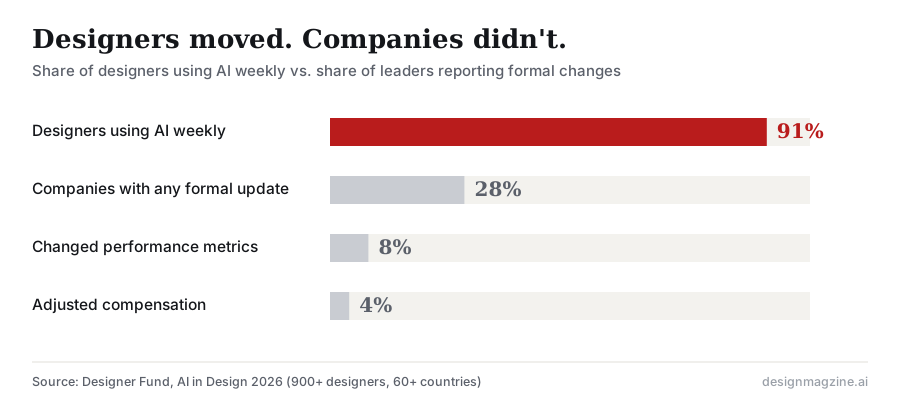
The gap, in plain numbers
Designer Fund surveyed more than 900 designers in over 60 countries for its second annual report, published May 20, 2026, and backed it with more than 25 interviews and case studies from teams at Anthropic, Framer, Linear, Notion, Shopify, Sierra and Stripe. On the designer side, the shift is close to total:
- 91 percent use AI weekly, up from 54 percent the year before.
- 75 percent use it every day.
- 73 percent say they feel rising expectations around output, quality and speed.
- 65 percent say they are taking on more product or engineering responsibilities.
On the company side, the report found that only 28 percent of leaders have made any formal update to evaluation, compensation or hiring. Drill down and it gets thinner: 8 percent changed performance metrics, and 4 percent adjusted compensation structure.
More output, same scorecard
Put those two lists next to each other and the story writes itself. Designers are being asked to move faster and do more, and three in four of them feel it. Many are now doing work that used to sit with product managers or engineers. Half say they have shipped AI-generated code to production.
Yet in most companies, the way that work is measured and paid has not moved. If only 8 percent of leaders report changing performance metrics, then at most companies a designer who now prototypes in code, runs three AI tools to produce twice the variations, and reviews everything the machine gets wrong is probably being judged on a scorecard written for a different job.
The bigger companies tell the same story
This is not just one survey. McKinsey's State of AI 2025 found that 88 percent of organizations now use AI regularly in at least one business function, up from 78 percent a year earlier. Yet only about a third say they are scaling AI across the enterprise. Use is everywhere. Structural change is not.
Microsoft's 2025 Work Trend Index, based on 31,000 workers in 31 markets, found that 82 percent of leaders expect to use AI agents as digital team members within 12 to 18 months, while 80 percent of employees say they lack the time or energy to do their work. Leaders are planning for an AI workforce. Employees are already stretched by the current one.
Where leaders did move: hiring
The one place companies are adjusting is the front door. Half of the design leaders surveyed say they now put more weight on AI fluency when they hire, followed closely by systems thinking and strategic skills. Only 5 percent say they care less about execution quality.
Adobe's own research shows how slowly that is reaching job listings. In its Future of Creative Work study, published June 2026, U.S. creative job postings that explicitly mention AI skills rose from 10 percent to 15 percent between September 2025 and April 2026. That means 85 percent still do not ask for AI skills at all, even though almost every designer now uses AI.
So the new expectations are being written into job ads before they are written into reviews and pay bands. That creates an odd situation inside teams. A new hire may be brought in partly for their AI skills, while the existing designer who taught themselves the same skills over the past year is still evaluated against older criteria.
Why companies are slow
To be fair to employers, there are reasons for caution. AI tools changed constantly this year. Adobe, Canva and Figma all shipped agent features in 2026, and many of them are still in beta or research preview. Midjourney released three versions of its V8 model between March and July. Writing a compensation framework around tools that change every quarter is hard.
Measurement is also genuinely difficult. The report found that unreliable output quality is designers' most common AI challenge. If AI makes a designer faster on some tasks but creates more cleanup on others, simple productivity numbers can mislead in both directions.
Still, "it's complicated" has a shelf life. When nine in ten people in a role have changed how they work, a 4 percent response rate on pay looks less like caution and more like inertia.
What designers can do now
- Document the new work. If you ship code, run agents or manage a stack of AI tools, write it down with examples. It is hard to be paid for work nobody has recorded.
- Bring the data to reviews. The Designer Fund numbers are public. Use them to start the conversation about updated metrics.
- Separate speed from quality. Show where AI saved time and where you spent time fixing its output. Both are part of the job now.
What leaders should take from this
The fastest way to lose a strong designer in 2026 may be to expect AI-era output while running a pre-AI review process. The data says your designers already changed. The next move belongs to the company.
Frequently asked questions
How many designers use AI in 2026?
According to Designer Fund's AI in Design 2026 report, 91 percent of designers use AI for design work weekly, up from 54 percent a year earlier, and 75 percent use it daily.
Have companies changed designer pay because of AI?
Very few. Designer Fund found that 28 percent of leaders say their company made formal updates to evaluation, compensation or hiring, 8 percent changed performance metrics and only 4 percent adjusted compensation structure.
What are companies changing instead?
Hiring. Half of design leaders surveyed say they now give more weight to AI fluency when hiring, followed closely by systems thinking and strategic skills.