AI Is Quietly Killing Design Teamwork: Complaints Up 4x in One Year
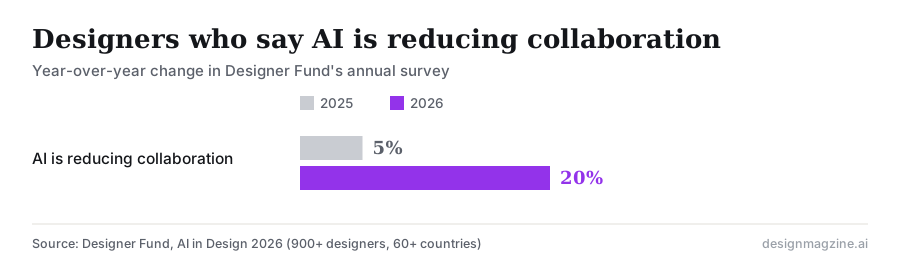
One in five designers now says AI is reducing collaboration on their team. A year ago it was one in twenty.
By Muhammad Anzal · 4 min read
AI was supposed to make design teams faster. According to new survey data, it may also be making them lonelier.
In Designer Fund's AI in Design 2026 report, 20 percent of designers said AI is reducing collaboration on their teams. A year earlier, that figure was 5 percent. That is a fourfold jump in twelve months, and it happened in the same year that weekly AI use among designers climbed to 91 percent.
Why the number is rising
The report does not break down the reasons, but its other findings point at a pattern. Think about how design work used to move. A designer sketched an idea, a colleague critiqued it, an engineer said what was feasible, and the design changed. Much of that loop now happens between one person and a tool.
- The first draft no longer needs a second person. With AI generating options in seconds, the early back-and-forth that used to happen in a critique can happen in a chat window.
- Roles are blurring. 65 percent of designers say they are taking on more product or engineering work, and 40 percent say product managers and engineers are contributing more to design. When everyone can generate a screen, fewer handoffs happen, and handoffs were where many conversations took place.
- The tool stack is fragmenting. The average designer now uses seven AI tools, up from three. More tools often means more private workspaces, chats and histories that colleagues never see.
Adobe's research points the same way. In its Future of Creative Work study, based on 1,433 working creatives surveyed in April 2026, only 24.1 percent of U.S. creative professionals said they use generative AI in reviews with collaborators. AI is heavily used for solo tasks such as brainstorming, where 81.7 percent rated the work as highly AI-enabled. The shared moments are where it shows up least.
Learning moved sideways, not up
There is a twist. Designers are not becoming isolated from each other entirely. The same report found that peer learning about AI jumped from 24 percent to 80 percent. Designers are swapping prompts, tools and shortcuts with colleagues constantly.
What seems to be shrinking is collaboration on the work itself: the shared critique, the joint problem-solving on a single design. Designers talk about AI together, then go back and work with it alone.
The tools are starting to respond
Some of the year's product launches read like answers to this exact problem. At Config 2026 on June 24, Figma opened its agent to all paid plans, and made a notable choice: chats with the agent are visible to collaborators in the file. Instead of a private conversation between one designer and an AI, the prompts and the reasoning sit where the team can see them.
Adobe's June 18 update to Firefly added a way for collaborators to review work before it is published. Canva's AI 2.0, announced April 16, added a Memory Library so the AI applies a team's shared style rather than each person's individual habits.
None of this fixes the problem on its own. A visible chat log is not the same as a colleague asking "why did you do it that way?" But it shows the companies have noticed that AI work tends to disappear into individual sessions.
Is this actually bad?
Not every drop in collaboration is a loss. Some meetings existed only because producing variations took a team. If AI lets one designer explore ten directions before lunch, fewer people need to be in the room for the boring parts.
The risk is losing the parts that mattered. Critique catches weak ideas early. Engineers flag what will break. A second pair of eyes is also the main defense against the problem designers named most often in the survey: unreliable AI output. Fewer people looking at the work means more AI mistakes reaching the final product.
What teams can do
- Make AI work visible. Share prompts, agent chats and rejected options, not only final screens.
- Keep critique on the calendar. If AI removed the natural moments for feedback, add them back on purpose.
- Review AI output in pairs. One person generates, another checks. It is the cheapest quality control available.
Twenty percent is still a minority. But a number that quadruples in a year is worth watching, and next year's survey will show whether teams found a way to work with AI without working alone.
Frequently asked questions
Is AI reducing collaboration in design teams?
In Designer Fund's AI in Design 2026 report, 20 percent of designers said AI is reducing collaboration, up from 5 percent the year before, a fourfold increase.
Are designers learning AI from each other?
Yes. Peer learning about AI rose from 24 percent to 80 percent of designers, even as collaboration on the work itself declined for some teams.
How are design tools addressing collaboration?
Figma's agent, opened to all paid plans at Config 2026, shows agent chats to collaborators in the file. Adobe's June 2026 Firefly update added a way for collaborators to review work before publishing.