80% of Designers Learn AI From Peers, Not Bosses. Leadership Is Falling Behind
Designers taught each other AI this year. Fewer of them are listening to leadership.
By Muhammad Anzal · 4 min read
If you want to know how designers actually learned AI, do not look at the company training calendar. Look at the desk next to them.
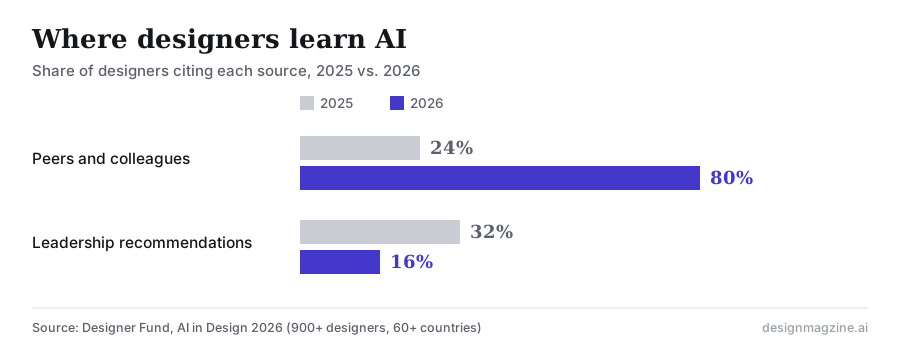
Designer Fund's AI in Design 2026 report found that 80 percent of designers now learn about AI from their peers, up from 24 percent a year earlier. Over the same period, the share who take AI recommendations from leadership fell from 32 percent to 16 percent. Peer learning more than tripled. Leadership's influence halved.
The bottom-up AI adoption story
This pattern did not start in design. Back in 2024, Microsoft and LinkedIn's Work Trend Index, a survey of about 31,000 people in 31 countries, found that 75 percent of knowledge workers were using AI at work and 78 percent of AI users were bringing their own tools. Only 39 percent of AI users had received AI training from their company, and 60 percent of leaders worried their organization had no clear plan for AI.
Microsoft's 2025 Work Trend Index shows the gap from the other side. Globally, 67 percent of leaders say they are familiar with AI agents and how to use them, compared with 40 percent of employees. Upskilling is named as organizations' top priority for the next 12 to 18 months. Leaders know the tools. The training has not reached everyone yet.
Two years later, the design numbers suggest the gap did not close. It widened. Designers picked up the tools on their own, taught each other, and kept going.
Creators outside companies behave the same way. Adobe's Creators' Toolkit survey of more than 16,000 creators found that people discover new AI tools mainly through personal research (58 percent), social media trends (57 percent) and recommendations from other creators (41 percent). Nobody in that list is a manager.
Why leadership is falling behind
Part of it is speed. In 2026 alone, Adobe shipped a creative agent and opened it across its main apps, Canva launched Canva AI 2.0, Figma put an agent on every paid plan, and Midjourney released three versions of its V8 model. A leadership recommendation written in January could be out of date by April. A colleague who tried the new feature yesterday is simply a better source.
Part of it is policy. Designer Fund found that only 28 percent of companies have made formal updates to evaluation, compensation or hiring because of AI. If the official system has not caught up, it is hard for leaders to give confident guidance about tools.
And part of it is culture. The report found that designers at companies with a culture of tinkering are twice as likely to say they feel more creative and capable. The teams doing best with AI are not the ones waiting for a memo.
Why that is a problem anyway
Peer learning is fast and practical, but it has gaps that leadership is supposed to cover:
- Licensing and rights. A colleague can show you a great image tool. They are less likely to have read its commercial-use terms.
- Data and privacy. Which tools can see client files, and which send prompts to third parties, is a company decision, not a peer tip.
- Consistency. If every designer learns a different stack from a different friend, a team ends up with seven tools per person and no shared standard.
- Quality. Unreliable output is designers' top AI complaint in the survey. Peer tips spread shortcuts quickly. They do not always spread the checks.
What good leadership looks like here
The answer is not for leaders to take control of AI learning back from designers. That ship has sailed, and the tinkering data suggests that is a good thing. The better role is to support what is already working.
- Formalize peer learning. Give it time and a place: a weekly demo, a shared channel, a library of tested prompts.
- Own the boring parts. Licensing, privacy, approved tools and file standards are where leadership guidance is still needed.
- Learn from the team. Leaders who sit in on peer sessions will make better tool and policy decisions than those who rely on vendor demos.
The numbers make the direction clear. Designers stopped waiting for permission to learn AI. The leaders who stay relevant will be the ones who catch up with their teams, not the ones who try to get ahead of them.
Frequently asked questions
How do designers learn AI?
According to Designer Fund's AI in Design 2026 report, 80 percent of designers learn about AI from peers, up from 24 percent. Only 16 percent take AI recommendations from leadership, down from 32 percent.
Do companies train employees on AI?
Microsoft and LinkedIn's 2024 Work Trend Index found that only 39 percent of AI users had received AI training from their company, and 78 percent of AI users brought their own AI tools to work.
What should design leaders do about AI learning?
Support peer learning with time and shared resources, and focus leadership guidance on licensing, privacy, approved tools and file standards.