73% of Designers Say AI Raised the Bar. Small Businesses Are the Real Winners
Professionals felt the pressure of AI this year. Small businesses felt the relief.
By Muhammad Anzal · 5 min read
Most AI design headlines this year were about professionals. Adobe's creative agent, Figma's Config launches and Canva AI 2.0 were all pitched at people who design for a living. And the professionals felt the pressure: in Designer Fund's AI in Design 2026 report, 73 percent of designers said they face rising expectations around output, quality and speed.
But look at who gained the most from the same tools, and a different group comes into view: small businesses.
The adoption curve nobody talks about
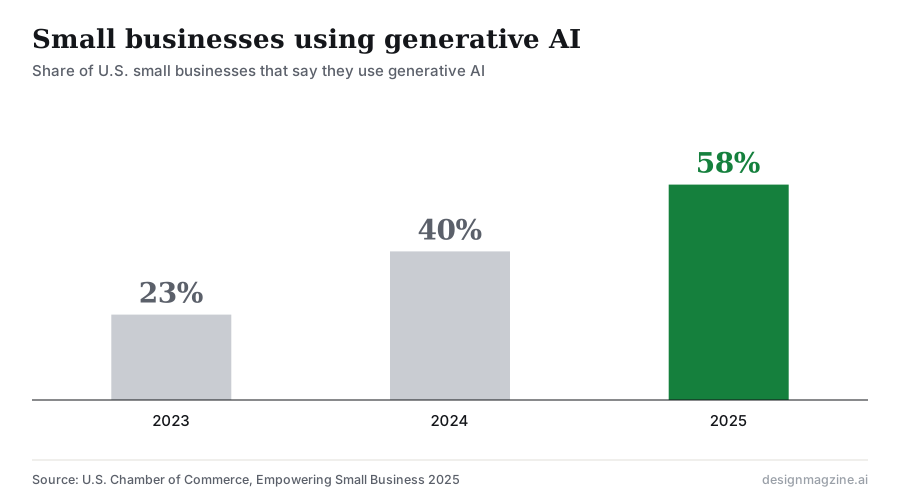
The U.S. Chamber of Commerce's Empowering Small Business report, published in August 2025 with Teneo Research, found that 58 percent of U.S. small businesses say they use generative AI. That is up from 40 percent in 2024 and 23 percent in 2023. Adoption more than doubled in two years.
The same report found that 82 percent of small businesses using AI increased their workforce over the past year, and 84 percent plan to increase their use of technology platforms. Whatever AI is doing for these businesses, it is not simply replacing staff.
The Chamber does not break down how much of that use is for design. But design is one of the most obvious places an owner feels the difference, because it used to mean either paying someone or doing without.
A wave of new creators is coming
Adobe's Future of Creative Work study, published in June 2026, adds a striking number. About 12 million American adults are now training to enter creative work, roughly three times the size of the current creative workforce and creative-major student population combined. Of those, 93 percent are career switchers, 56 percent have no formal creative education, and 77 percent rate generative AI as extremely or very important to their future career.
Small companies are leaning in too. Figma's 2025 AI report found that 61 percent of users at companies with 1 to 10 employees call AI very or critically important to their market share goals. And Adobe's analysis of job postings found only 8 percent of solo and small-business creative listings require AI skills, against 18 percent at larger companies. One likely reason is that many small businesses use AI design tools directly instead of hiring for the skill.
Why the pressure lands differently
For a professional designer, AI raised the bar. Faster tools mean clients and managers expect more variations, quicker turnarounds and code-ready output. Designers now juggle seven AI tools on average, and their top complaint is unreliable output.
For a small business owner, the same tools lowered the floor. A logo, a menu, a sale flyer or a week of social posts used to require hiring a designer or wrestling with software. Now the starting point is a sentence.
That is the real asymmetry in this year's news. The professional's job got harder to do well. The owner's job got easier to do at all.
What the tools now let a non-designer do
- Start from a description. Canva AI 2.0, announced April 16, 2026, lets users create a design by describing an idea and refine it through conversation. Canva says more than 250 million people use it every month.
- Keep a brand consistent. Canva added automatic brand kits built from a website URL in September. Adobe added brand kit creation to Firefly in June.
- Go from prompt to printed file. Small-business platforms such as Design.com combine the whole flow: type what you need with your business name and industry, pick from AI-matched templates, adjust the design by chatting with an AI editor, then download print-ready files in formats like SVG, EPS, PDF, PNG and MP4. The free plan includes a handful of AI generations, so an owner can test the process before paying anything.
The catch
Winning does not mean winning without effort. The same quality problem professionals complain about applies to everyone. AI can misspell a business name, produce a logo that looks like a competitor's, or create a file that prints badly. Professionals have the training to catch those issues. Owners often do not.
There is also the question of ownership. Before a business prints signs or registers a logo, it should know whether it has commercial rights to the design and can download editable vector files. Those details matter far more than which AI model drew the first version.
What small businesses should do now
- Use AI for the volume work. Social posts, flyers, menus and promotions are where AI saves the most time.
- Spend on what lasts. For your core logo and brand, check the rights, get vector files and consider a professional review.
- Proofread everything. Names, prices, phone numbers and dates. AI gets them wrong more often than you would expect.
Seventy-three percent of designers say AI raised the bar. For the 58 percent of small businesses now using generative AI, it lowered the barrier. Both things can be true, and in 2026 they are.
Frequently asked questions
How many small businesses use generative AI?
The U.S. Chamber of Commerce's 2025 Empowering Small Business report found that 58 percent of U.S. small businesses use generative AI, up from 40 percent in 2024 and 23 percent in 2023.
How has AI changed expectations for designers?
In Designer Fund's AI in Design 2026 report, 73 percent of designers said they feel rising expectations around output, quality and speed.
Can small businesses design with AI without a designer?
Yes for everyday assets. Tools such as Canva AI 2.0 and Design.com let owners describe what they need, refine the design by chat and download files. For a core logo, owners should check commercial rights and get editable vector files.