Google's Nano Banana 2.1 Fixes AI's Biggest Design Problem: Text
A quiet October update makes Google's popular image model better at lettering, layouts and keeping characters consistent.
By Muhammad Anzal · 4 min read
Google quietly shipped one of the most useful image model updates of the year on October 6. Nano Banana 2.1, an update to the Gemini image model that has become a default choice for a lot of AI design work, now handles text, layouts and multi-image edits better than the version designers have been using since its launch.
There was no big keynote. The change showed up in Google's Gemini API documentation, listed under the model ID gemini-nano-banana-2.1 and marked as a stable release.
What actually changed
According to Google's documentation, Nano Banana 2.1 is an update to Nano Banana 2 (Gemini 3.1 Flash Image) and is positioned as the faster, more efficient counterpart to Nano Banana Pro (Gemini 3 Pro Image). The upgrades are practical rather than flashy:
- Better text and layouts. Google says text rendering and infographic layout accuracy improved, helped by grounding in Google Web and Image Search.
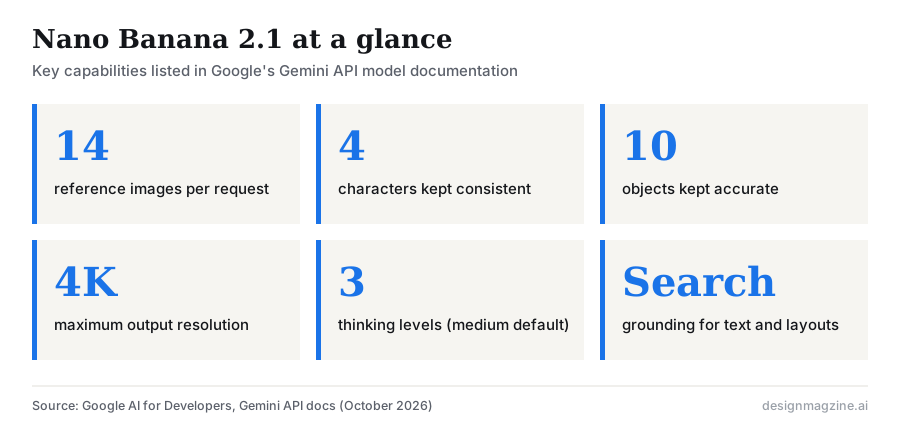
- More references. One request can combine up to 14 reference images, keep up to four characters consistent and keep up to ten objects accurate.
- Cleaner wide formats. Tiling artifacts that appeared in 2K and 4K output at extreme aspect ratios such as 1:4, 4:1, 1:8 and 8:1 are fixed.
- A middle thinking setting. Users can choose minimal, medium or high thinking. Medium is now the default. Nano Banana 2 only offered minimal and high.
- More input types. The model accepts text, images, video and PDFs, and returns images and text. Output comes in 1K, 2K or 4K.
Why designers should care
For anyone making real deliverables, two of these changes matter more than the rest.
The first is text. Garbled lettering has been the giveaway of AI images for years, and it is the reason many designers still rebuild posters, menus and social graphics by hand after generating them. Better text rendering and infographic layout means fewer of those rebuilds.
The second is consistency. Brand work depends on the same character, product or mascot looking the same across a campaign. Supporting four consistent characters and ten accurate objects in one request moves the model closer to producing a usable set of assets, not just one good image.
Where you will see it
Developers can use Nano Banana 2.1 through the Gemini API now, including the Batch API. It is also likely to show up inside the design tools people already use. Adobe already lists Nano Banana 2 and Nano Banana Pro among the partner models in Firefly, and third-party creative platforms such as Artlist added 2.1 within days.
That is the pattern for 2026: a model update ships quietly in an API, then spreads into dozens of apps over the following weeks. Most designers will meet Nano Banana 2.1 without ever choosing it by name.
The bigger trend: editing by conversation
Nano Banana 2.1 leans further into conversational editing, where you change an image by describing the change instead of reaching for selection tools. Google lists conversational editing as a core capability, and reviewers highlighted better targeted edits that change only the area you describe.
That approach is now everywhere in design software. Canva AI 2.0 is built around it, Adobe's AI Assistant uses it across Photoshop and Illustrator, and small-business tools work the same way. On Design.com, for example, you pick an AI-generated template and then refine it by chatting with an AI editor, asking for a new color, layout or font in plain words. Better underlying models like Nano Banana 2.1 make that kind of chat-based editing more reliable across the board.
What to watch
- Pricing. Google's model page does not list per-image prices, so check the Gemini API pricing page before switching production work.
- Rollout in apps. Watch for 2.1 to appear in the Gemini app, Adobe Firefly and other tools that already offer Nano Banana 2.
- Text in the real world. "Improved text rendering" is a claim worth testing with your own brand name, prices and small print before trusting it.
Nano Banana 2.1 is not a new generation. It is the kind of update that makes an existing tool noticeably more dependable, and for working designers that often matters more.
Frequently asked questions
What is Nano Banana 2.1?
Nano Banana 2.1 is an update to Google's Nano Banana 2 (Gemini 3.1 Flash Image) model, released on October 6, 2026. It is available in the Gemini API under the model ID gemini-nano-banana-2.1.
What is new in Nano Banana 2.1?
Google lists improved text rendering and infographic layouts, up to 14 reference images per request, consistency for up to four characters and ten objects, fixed tiling at extreme aspect ratios in 2K and 4K, and three thinking levels with medium as the default.
Where can I use Nano Banana 2.1?
Developers can use it through the Gemini API now. Third-party creative platforms such as Artlist added it within days, and Adobe Firefly already offers earlier Nano Banana models as partner models.