Microsoft's Maia 300 Chip Is a Bet Against the GPU Bill
Microsoft's third-generation AI chip targets the most expensive part of AI: running models every day.
By Muhammad Anzal · 4 min read
Every AI answer, image and agent action runs on chips, and most of those chips come from one company. On October 12, Microsoft made its clearest move yet to change that. It unveiled Maia 300, its third-generation in-house AI accelerator, and said it plans to scale its Maia systems to multi-gigawatt deployments in 2027.
What Microsoft announced
According to Microsoft's announcement, as reported by Data Center Knowledge:
- Inference first. Maia 300 is designed mainly for running AI models, not training them, which is where most day-to-day AI cost sits.
- 40 percent more tokens per megawatt. Microsoft expects Maia 300 to produce 40 percent more AI output per unit of power than leading GPU-based systems.
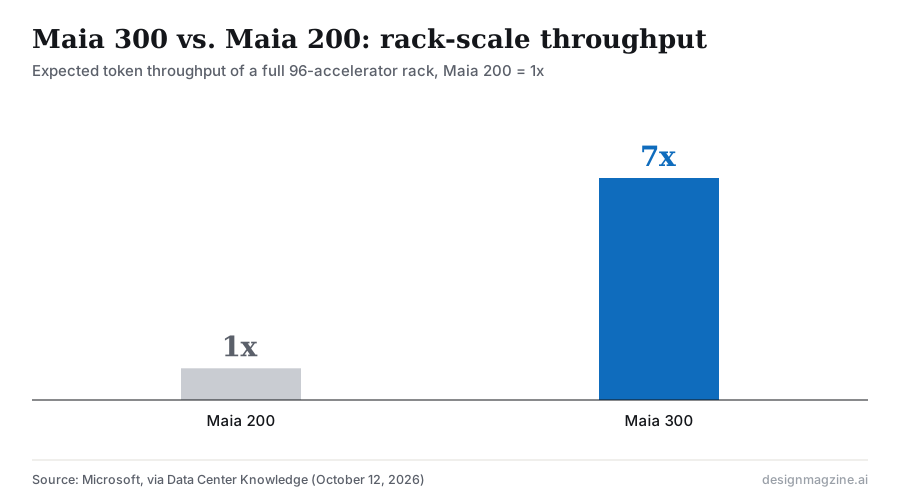
- Up to 7x rack throughput. In a full 96-accelerator rack, Microsoft expects up to seven times the token throughput of Maia 200.
- 2027 production. Maia 300 is planned for production next year, with the Azure Maia family scaling to multi-gigawatt deployments.
Its predecessor is already in service. Microsoft says Maia 200 is deployed in data centers in the United States, Europe and Australia and helps power Copilot and other services, delivering up to 1.7 times more tokens per watt than leading GPU infrastructure.
Why "per megawatt" is the number that matters
A year or two ago, the AI conversation was about how many GPUs a company could buy. Now it is increasingly about how much electricity a data center can get. That is why Microsoft is measuring Maia 300 in tokens per megawatt rather than raw speed. If the same power budget produces 40 percent more output, every new data center goes further.
It also explains the focus on inference. Training a frontier model is a huge one-time cost. Running it for hundreds of millions of users, every day, is the bill that never stops. A chip built to make that cheaper goes straight at the biggest ongoing expense in AI.
The NVIDIA question
Microsoft is not leaving NVIDIA or AMD. It has said its own silicon is meant to work alongside them. But every workload that runs on Maia is one that does not need a GPU bought from someone else. Google has followed the same path with its TPUs, Amazon with its Trainium and Inferentia chips, and now Microsoft is scaling its own program to the same level.
The result is a market where the biggest cloud providers are slowly becoming chipmakers too.
Why it matters to everyone else
Most people will never see a Maia chip. They will see its effects. Cheaper inference is a big part of why AI features keep getting faster and why model prices keep falling. Anthropic cut prices for Claude Haiku 5.5 by about 75 percent this month, and Microsoft's Azure is one of the platforms where it runs. More efficient chips like Maia 300 are one of the things that make price cuts like that sustainable for cloud providers.
For designers and businesses, the practical effect over the next few years is likely to be more AI in more tools, for less money. That includes the image generators, editing assistants and agents now built into everyday creative software.
What to watch
- Delivery in 2027. These are expected figures for a chip not yet in production. The real numbers will come when it is deployed.
- Who runs on it. Watch which Microsoft and partner AI services move onto Maia 300 first.
- Power deals. Multi-gigawatt plans depend on securing the electricity to match.
Frequently asked questions
What is Microsoft Maia 300?
Maia 300 is Microsoft's third-generation in-house AI accelerator, announced on October 12, 2026. It is designed mainly for inference, the work of running AI models for users.
How fast is Maia 300?
Microsoft expects Maia 300 to deliver 40 percent more tokens per megawatt than leading GPU-based systems, and up to seven times the rack-scale token throughput of Maia 200 in a 96-accelerator rack.
When will Maia 300 be available?
Microsoft plans to put Maia 300 into production in 2027 and scale its Azure Maia systems to multi-gigawatt deployments that year.