Meta's Muse Wonder Joins the Frontier, But the Best Version Is Paywalled
Meta's first frontier-class models are built for agents, priced like the leaders and split between API and subscribers.
By Muhammad Anzal · 4 min read
Meta has spent years releasing open models and chasing the leaders. On October 12, it released something different: Muse Wonder and Muse Wonder Full, which Meta calls its most capable models to date, built for "personal and professional agentic tasks." The bigger version lands within two points of the top model on one widely watched index.
Two models, two audiences
Meta split the release in a way that tells you a lot about its business plan.
- Muse Wonder is available to developers now through the Meta Model API and Muse Code, and will soon power Meta's Muse assistant, starting with subscribers. VentureBeat reports API pricing of $4 per million input tokens and $20 per million output tokens.
- Muse Wonder Full, the stronger model, is not available through the pay-as-you-go API at all. It is only offered to Muse Code subscribers, on plans VentureBeat lists at $50 and $200 a month.
In other words, the best version is a reason to subscribe. CNBC framed the launch as a test of whether Meta's users are willing to pay for AI, and the structure supports that reading.
How good is it?
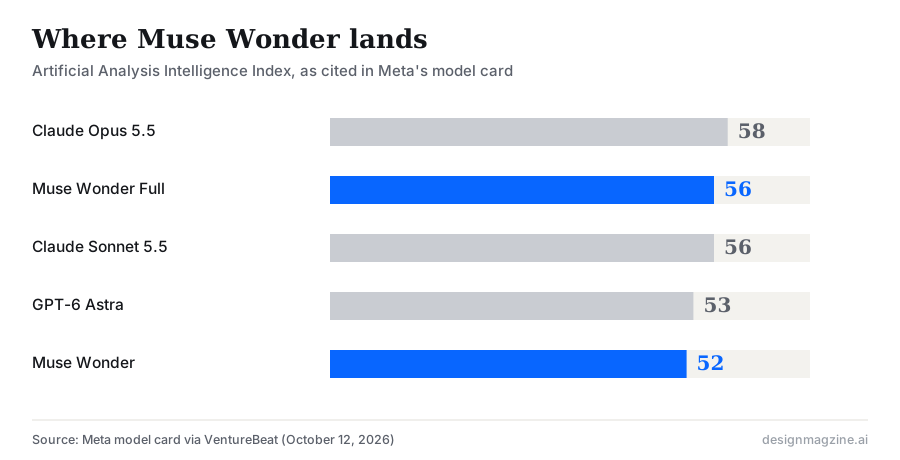
On the Artificial Analysis Intelligence Index cited in Meta's model card, Muse Wonder Full scores 56, tying Claude Sonnet 5.5 and behind only Claude Opus 5.5 at 58. The standard Muse Wonder scores 52, just under GPT-6 Astra at 53.
The individual benchmarks are more mixed. According to VentureBeat's summary of the model card, Wonder Full leads on legal reasoning, business workflow automation and long software-engineering tasks, while Claude Opus 5.5 leads on the overall index, terminal tasks and health questions. VentureBeat also notes that Meta's comparisons mix internal, vendor-supplied and third-party results, so they should be read with care.
Why this is a big moment for Meta
Muse Wonder builds on Muse Spark and follows the launch of Muse, Meta's personal AI agent, in September. That agent can send emails, book travel and handle tasks across connected apps. Muse Wonder is the engine Meta wants inside it.
Two things stand out. First, these models are proprietary, with no downloadable weights, a clear shift for a company once known for open releases. Second, Meta is targeting high-value work such as legal documents, finance, health and coding rather than chat and entertainment. Meta's own examples include handling an insurance claim, interpreting a lease and building a working app.
The fine print
- Data use differs by product. VentureBeat reports that API usage runs in a mode where submitted content is not used for training, while Muse Code subscriptions default to a mode that allows Meta to use submitted data to improve its models.
- The safety report is still coming. Meta says a full safety report will be available soon.
- Benchmarks are early. Independent testing over the next few weeks will show how the models hold up outside Meta's own comparisons.
What it means
For most of the AI race, the top tier has been OpenAI, Anthropic and Google. Muse Wonder Full puts Meta within touching distance of that group on at least one major index, and its pricing puts the standard model in the same range as other frontier options. Whether people will pay Meta for AI is now the real question, and Muse Wonder is the first serious test.
Frequently asked questions
What is Meta Muse Wonder?
Muse Wonder and Muse Wonder Full are Meta's most capable AI models to date, released on October 12, 2026 and built for personal and professional agentic tasks such as legal, finance, health and coding work.
How does Muse Wonder compare with other models?
On the Artificial Analysis Intelligence Index cited in Meta's model card, Muse Wonder Full scores 56, tying Claude Sonnet 5.5 and trailing Claude Opus 5.5 at 58. Muse Wonder scores 52.
How can I use Muse Wonder Full?
According to VentureBeat, Muse Wonder Full is only available to Muse Code subscribers, while the standard Muse Wonder is available through Meta's API at $4 per million input tokens and $20 per million output tokens.