Claude Haiku 5.5 Cuts AI Costs by 75%. Here's What That Changes
Anthropic's new small model is faster, smarter and a fraction of the price of its predecessor.
By Muhammad Anzal · 4 min read
Anthropic released Claude Haiku 5.5 on October 7, and the headline is the price. According to Anthropic, the new small model costs about 75 percent less to run on average than Haiku 4.5. For shorter prompts, the cut is closer to 90 percent.
It is also, in Anthropic's words, its fastest and most capable small model, and the first in the Haiku line that lets developers dial its effort up or down.
The pricing, in detail
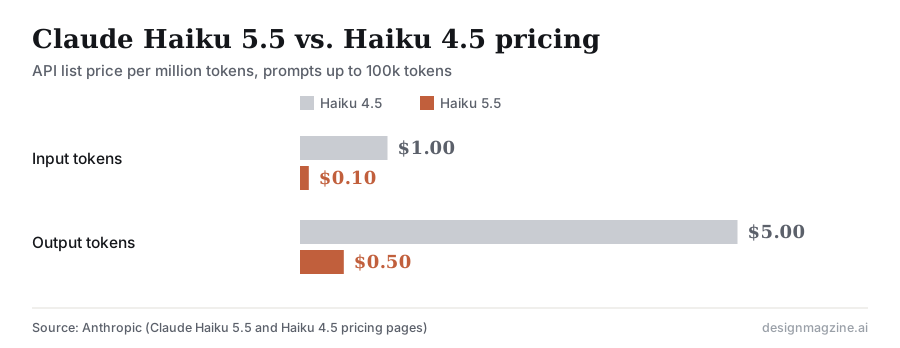
Haiku 5.5 uses two-tier pricing based on prompt length. For prompts up to 100,000 tokens, it costs $0.10 per million input tokens and $0.50 per million output tokens. Above 100,000 tokens, prices rise to $0.50 and $2.50. Cache reads start at $0.01 per million tokens.
Anthropic says that works out to roughly a 90 percent reduction for prompts under 100,000 tokens and about 50 percent for longer ones, with an average saving of around 75 percent compared with Haiku 4.5.
What it is built for
Haiku has always been Anthropic's workhorse for jobs that run thousands or millions of times. Anthropic lists the use cases plainly:
- High-volume tasks such as summaries, classification, compaction and database queries.
- Sub-agents working alongside Claude Opus 5.5 and Sonnet 5.5 on larger coding tasks, where a cheaper model handles the routine steps.
- Live work such as customer support and browser use, where speed matters as much as intelligence.
Computer use and browser use are available in beta through the Python and TypeScript SDKs. The model is available through Anthropic's API and on Amazon Web Services, Google Cloud and Microsoft Azure.
Why this matters beyond developers
Most people will never call Haiku 5.5 directly. They will use it inside other products. Small, cheap, fast models are what power the AI features in everyday apps: the instant summary, the support chat, the auto-generated caption, the background agent that sorts a request before a larger model gets involved.
When the cost of those calls drops by 75 to 90 percent, two things tend to happen. Companies add AI features they previously could not afford to run at scale, and free tiers get more generous. For design and marketing tools, that can mean more AI help in places like copy suggestions, asset tagging, brief summaries and customer chat, without a price increase.
The price war in small models
Haiku 5.5 lands in a crowded month. Google, Meta, Microsoft and Mistral all shipped models in the first two weeks of October. The pattern across the industry is clear: the biggest models compete on capability, while the small ones compete on cost and speed. Anthropic's move puts a capable small model at a price that makes it easy to run everywhere.
What to watch
- Real-world quality. A cheaper model only saves money if it gets the task right. Teams should test their own prompts before switching.
- Long-prompt costs. The best pricing applies under 100,000 tokens. Workloads with very long inputs will see smaller savings.
- Effort settings. The new effort dial gives developers more control, and more choices to tune. Expect best-practice guides to follow.
Haiku 5.5 is not the most powerful model released this month. It may be one of the most widely used.
Frequently asked questions
When was Claude Haiku 5.5 released?
Anthropic released Claude Haiku 5.5 on October 7, 2026. Its model ID is claude-haiku-5-5.
How much does Claude Haiku 5.5 cost?
For prompts up to 100,000 tokens, Haiku 5.5 costs $0.10 per million input tokens and $0.50 per million output tokens. Longer prompts cost $0.50 and $2.50. Anthropic says it costs about 75 percent less than Haiku 4.5 on average.
What is new in Claude Haiku 5.5?
It is the first Haiku-class model with an adjustable effort setting, and it supports computer use and browser use in beta. It is available through Anthropic's API and on AWS, Google Cloud and Microsoft Azure.