Google Wants AI Search to Send More Clicks. Here's What Changed
Five changes to AI Mode and AI Overviews push links to websites higher and make them bigger. Google shared no click data to show they work.
By Muhammad Anzal · 5 min read
Google is redesigning how its AI-generated answers point people to the open web. In an October 15, 2026 post on its Keyword blog, titled More ways to connect with the web from Search, the company announced five changes to AI Mode and AI Overviews that push links to websites higher, make them larger, and place them in more parts of each response.
The update was written by Hema Budaraju, Google's Vice President of Product Management for Search. It arrives as publishers continue to report steep traffic losses from AI summaries, and as Google faces growing pressure to show that its AI search features still send visitors outward. Notably, the announcement includes no click-through data to show whether the new link placements actually work.
The five changes
The changes range from full launches to early tests, according to Google's announcement. Google did not name specific countries or languages for any of them.
- Inline links, moved higher. Inline links are clickable words or phrases inside an AI response. Google says it has steadily increased how often they appear, and is now launching updates so they show up nearer the top of answers more frequently. The goal is to make key sources clickable at the moment a reader reaches them. Google gave no figures on how often or how much higher.
- A dedicated section for official sites (test). For tasks where only one or two official websites can help, such as completing a government form, Google will test a new section at the top of AI responses. It will surface those official links prominently and explain why each one is useful. Google has not said how it will decide which sites count as "official," or when the test begins.
- News carousels in more markets. The article carousels that appear for timely topics, first introduced in May 2026, are rolling out to additional locations and languages. These carousels highlight sources a user has marked as a Preferred Source.
- Bigger links at the end of responses. Links shown at the close of some AI answers are getting image thumbnails and a more clickable design, aimed at people who want to explore a topic further. This looks like a redesign of the "Explore new angles" section Google added in May.
- Clickable creator names in AI Mode (test). Starting the week of October 12, Google began testing clickable creator and publisher names on video results in AI Mode. Clicking a name opens that creator's Search profile, the Google-hosted pages that launched in the US in June.
Why now
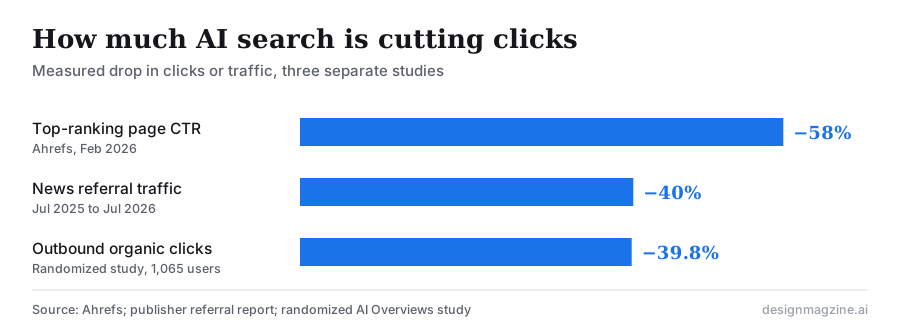
The update lands amid sustained evidence that AI summaries are eating into publisher traffic. One report recorded a 40% drop in Google referral traffic to news publishers between July 2025 and July 2026. A randomized study of 1,065 US participants found AI Overviews cut outbound organic clicks by 39.8%. Ahrefs measured a 58% click-through reduction for top-ranking pages in February 2026.
The stakes are large. AI Mode passed one billion monthly users by May 2026, and AI Overviews reportedly reaches more than 2.5 billion. Regulators are also watching: a UK Competition and Markets Authority conduct requirement for publishers takes legal force on December 3, 2026.
This is also not Google's first attempt. In May 2026, Budaraju announced a separate batch of five outbound link features, including inline links and desktop hover previews. Two of the October changes refine features from that earlier release.
Preferred Sources grows 7x
Google opened its post with one adoption figure: the number of people using its Preferred Sources feature has grown more than sevenfold since January. Preferred Sources lets searchers choose outlets they want to see more often in results.
Google did not share the January baseline or define what counts as "use." Its earlier milestones counted unique sources selected rather than people: nearly 90,000 in December 2025, more than 345,000 in May 2026, and more than 600,000 by August 2026.
Site owners are only starting to see their own numbers. On October 6, Google began emailing some site owners a single count of how many people had chosen them as a preferred source. There is still no Preferred Sources report inside Search Console.
What's still missing: click data
The biggest gap in the announcement is measurement. Google describes more links, larger links and earlier links, but publishes no data on how many clicks they produce. Search Console still does not report clicks from AI Mode or AI Overviews separately.
That leaves site owners unable to verify the impact themselves. In July, Google Search SVP Nick Fox said AI features send "billions of clicks to websites every week," but offered no denominator. Google says it will keep refining these features based on what works, without saying which metrics it will use.
The post is also loose on status and reach. One change is "launching," one is "starting to roll out," two are tests, and one has no status at all. No country, region or language is named for any change.
What it means for publishers and SEOs
The changes reward different things, and site owners should plan for each:
- Being cited early. Higher inline links favor sources the AI chooses to reference near the top of its answer. Clear, quotable, well-structured content matters more.
- Reader loyalty. Carousels lean on Preferred Sources, so publishers that get readers to select them gain an edge. Google released an embeddable Preferred Sources button for this in August.
- Official status. The official-sites test could concentrate task-based clicks on one or two domains. Informational sites that explain processes, such as how-to guides, may lose some of that long-tail traffic.
- Creator profiles. Eligible creators should claim their Search profile. But the clickable-name test routes viewers to a Google-hosted page first, not straight to the creator's own site.
Until Google adds AI click reporting to Search Console, the safest approach is to track referral traffic and AI citations independently, and to treat these changes as an opportunity rather than a guaranteed recovery.
Frequently asked questions
What did Google change in AI Mode and AI Overviews?
On October 15, 2026, Google announced five changes: inline links that appear nearer the top of AI answers, a test section for official websites, news carousels in more markets, larger links with thumbnails at the end of responses, and a test of clickable creator names on video results in AI Mode.
Will these changes bring back lost traffic?
It is unclear. Google published no click-through data for the new link placements, and Search Console still does not report clicks from AI Mode or AI Overviews separately, so site owners cannot yet measure the impact.
What is Google Preferred Sources?
Preferred Sources lets searchers choose outlets they want to see more often in results. Google says the number of people using it has grown more than sevenfold since January 2026, and the new news carousels highlight these chosen sources.